Monday, August 11, 2025

The Evolution of Chinese Character Expression Forms and the “Outline Method” for Chinese Teaching

 By Lewei Shang

August 10, 2025


Part 1, The evolution of Chinese character expression forms

Many years ago, during a lecture on the pictographic origins of Chinese characters, an elderly white gentleman asked me: “Do Chinese characters have letters?”
I had never imagined anyone would ask such a question, to the point that I started doubting whether I’d understood him correctly. I asked again, and confirmed that he really was asking, “Do Chinese characters have letters?”
My first reaction was, “How could anyone ask such an unrealistic question?” Then I honestly told him: “Chinese characters don’t have letters.”

But that question forced me to think: Why don’t Chinese characters have letters? Do Chinese characters have something similar to letters?

What is a letter? A letter is the smallest unit in an alphabetic writing system, used to form words. Chinese is not an alphabetic writing system, so naturally it has no letters. But does it have a smallest independent unit — a structure that, like letters, cannot be divided further?
After some thought, I concluded that Chinese does have such units: independent characters that cannot be split. For example: 
日 (sun), 月 (moon), 火 (fire), 土 (earth), 人 (person), 水 (water), 牛 (ox), 马 (horse), 山 (mountain), 女(woman), 口 (mouth), 门 (door), 目 (eye), 田 (field), 心 (heart), 木 (tree), and so on.

The difference between these “independent characters” and letters is that independent characters have meaning, while letters do not. But functionally, in terms of forming larger linguistic units, they are similar.
Another difference: alphabets usually have only 20–30 letters, while Chinese has about 400 independent characters — more than ten times as many. These 400+ are combined to form tens of thousands (or even over a hundred thousand) compound characters.
For example: 
明 (bright), 看 (look), 灶 (stove), 妈 (mother), 吐 (spit), 炎 (flame), 休 (rest), 森 (forest), 林 (woods), 泪(tear), 思 (think), 相 (mutual). These are formed from two or more independent characters.

The emergence of compound characters allowed Chinese writing to expand from representing only tangible objects to expressing abstract concepts. For example: 明, 看, 休, 好, 思 are verbs or adjectives with no concrete shape. This greatly enhanced the expressive power of Chinese.

But even then, Chinese characters were still not enough — there were numbers, pronouns, and new concepts constantly emerging. What to do? Our ancestors invented loan characters (假借) and mutual explanation (转注).

  • Loan characters: If there’s no existing character to express a meaning, borrow one temporarily. For example, 它originally meant “snake.” But since “it” (pronoun) had no character, 它 was borrowed for the pronoun. Over time, the pronoun meaning became far more common than the original “snake” meaning. People forgot 它 meant “snake,” so a new character 蛇 (with the “insect” radical) was created to restore the original meaning. Because the original character wasn’t returned, this is called loan borrowing.
  • Mutual explanation: One character acquires multiple related meanings. For example, 乐 (lè, yuè), 重 (zhòng, chóng), 省 (shěng, xǐng), 行 (háng, xíng), 恶 (è, wù), 觉 (jiào, jué), etc. For instance, 乐 meaning “happy” (lè) didn’t have its own character, so the 乐 meaning “music” (yuè) was also used for “happy.” Unlike loan borrowing, no new character is created — it’s more convenient but leads to common misinterpretations, because one character can have several meanings, and learners may not master them all at once.

Some may ask: “How do you know which came first, yuè or lè?” I can say with certainty: yuè came first — you can see it from shell bone inscription.

For example, this is a set of bronze chime bells: bells on top, frame below. Chime bells are, of course, for playing music, so 乐 originally meant a musical instrument.
In many cases, we can’t be sure which meaning came first. But regardless, the result is the same: one character with multiple meanings. In fact, 99% of such polysemy comes from mutual explanation.

Even so, there still weren’t enough characters. Creating new ones is difficult and slow. What to do? Our ancestors invented word compounds — two or more characters combined to express a meaning. For example, “电脑” (computer) is formed from 电 (electricity) and 脑 (brain), instead of creating a brand-new character for “computer.”

This method works for endless terms: 计算机 (computer), 打印机 (printer), 割草机 (lawn mower), 拖拉机 (tractor), 推土机 (bulldozer), 洗碗机 (dishwasher), 订书机 (stapler). Whatever the machine, I can make a compound to name it. Same with vehicles: 马车 (horse carriage), 牛车 (ox cart), 汽车 (car), 火车 (train), 面包车 (van), 轿车 (sedan), 卡车(truck), 云霄飞车 (roller coaster), 班车 (shuttle bus), 板车 (flatbed cart), 自行车 (bicycle), 三轮车 (tricycle).

This also works with diseases: 胃病 (stomach illness), 肺病 (lung illness), 心脏病 (heart disease), 糖尿病 (diabetes). Making new compounds is far easier than inventing a new character for each disease.

The invention of compounds freed Chinese from the constant pressure to create new characters. Compound words also express meaning more precisely and subtly, and reduce confusion from homophones. For example, the single character 地sounds similar to 弟, 第, 帝, 蒂, 迪, 递, etc., which can cause misunderstandings. But in the compound 土地 (“land”), the meaning is clear, and full-homophone compounds are rarer than single-character homophones.

Our ancestors also invented reduplication: 清清楚楚 (very clear), 干干净净 (very clean), 漂漂亮亮 (very beautiful), 马马虎虎 (careless), 上上下下 (up and down). This largely solved homophone confusion.


Part 2, Outline Method for teaching Chinese

Inspired by the above thinking, I recently developed a new approach to teaching Chinese: learning should start with independent characters. There are about 400 — not too many, and you don’t need them all. They are highly pictographic, so introducing their shapes and evolution makes them easy to learn without rote memorization.

For example, the independent characters 日, 月, 水, 火, 土, 山, 女, 口, 牛, 马, 门, 目, 木, 人. 日 is a circle with a dot in the center. 山 is three peaks. 口 is a square.

Once you’ve learned them, move on to compound characters — they’re just combinations of the independent ones, easy to understand and remember, like building with blocks: 日 + 月 = 明 (bright), 门 + 口 = 问 (ask), 女 + 马 = 妈 (mother), 火 + 土 = 灶 (stove), 水 + 目 = 泪 (tear).

Finally, learn compounds: also like building blocks. 泪水 (tears), 土灶 (earthen stove), 好马 (good horse), 妈妈 (mother), 儿子 (son), 好人 (good person), 门口 (doorway), 明月 (bright moon).

I call this the “Outline Method” for Teaching Chinese Characters:

  • Independent characters are the outline (纲)
  • Compound characters are the main headings (目)
  • Compound words are the subheadings (次目)

Grasp the outline (independent characters), and you lift up the main headings (compound characters). Lift those, and the subheadings (words) follow.

Example with 日: 

shell bone script

  • 日 is the outline (independent character)
  • Compound characters from 日: 早, 明, 星, 春, 时
  • Words from these:
    • 早 → 早晨, 早饭, 早操, 早退, 早自习
    • 明 → 明天, 光明, 明显, 明月, 发明, 聪明
    • 星 → 星光, 星火, 星辰, 零星, 卫星, 明星
    • 春 → 春天, 春节, 春季, 春风, 春雨, 春联
    • 时 → 时间, 时代, 时差, 时钟, 临时, 倒计时

So the evolution of Chinese character expression can be summarized as:


Independent characters → Compound characters → Compound words

This makes learning easier, faster, and more memorable. Combined with basic Chinese grammar, it forms a rich and complete language.


Wednesday, July 30, 2025

Amazing Chinese Characters (762) Sudden - 乍

The shell bone script of character Sudden is


the top is axe blade, the bottom is firewood or a trunk. The swinging axe blade spliting a firewood or a trunk makes sudden and big sound, which is the meaning of the character.

The bronze script of character Sudden is

It is possible from the reverse of shell bone script


The angles are different and the right vertical (close vertical) line extends to touch the next diagonal line just below. Why? I don't know.

The big seal script of character Sudden is

similar to the bronze script. 

The small seal script of character Sudden is


Similar to big seal and bronze scripts except the right top, the reason why it changed like that? I don't know.

The clerical script of character Sudden is

Not much similarity to old scripts. However, we could get some hints: the top is from the top right 人 in small script, the bottom is a little bit similar to the left and bottom of small seal script.

The Pinyin of the character is Zha4.


Sunday, July 13, 2025

Amazing Chinese Characters (761) Larva - 孓

The big seal script of character Larva is


similar to big seal script of character Child

The difference is that the character Child has two arms not upward, but Larva has only one arm up, another downward. What does it mean? I guess it means that the arm downward implies the child is weak like Larva. So its original meaning is small and weak.

The small seal script of character Larva is

which is similar to character Alone


just missing an arm on the different side, here it means Alone too, which is different from Small and Weak, or Larva. I guess is that the character evolved, the meaning of Larva gradually lost, but not completely, the new meaning of Alone was added on, especially when people used the two characters 孑孓 together, which emphasizes the Along, or Lonely. 

The clerical script of character Larva is

the middle line is different direction from that in character Alone (孑)

The Pinyin of the character is Jue2.

The character is used rarely alone. occasionally used with 孑:孑孓, meaning is Lonely.


Amazing Chinese Characters (760) Alone - 孑

The big seal script of character Alone is

A little child with only one arm. 

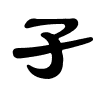
Let's us compare the big seal script of character Child (Post 21)

A child with both arms.

Which arm is missing? Depends on what you think the position of the child, if the child is facing us, he is missing right arm; if he is back to us, he is missing left arm. By 《說文解字》(the most famous dictionary in Chinese history, it is missing left arm, therefore, the child is back to us. 

Normal people have two arms, single arm implies not paired, no partner, alone.

The small seal script of character Alone is

Right arm is missing? Which conflicts with the big seal script. Therefore, even 《說文解字》might make mistakes. What I think is that it just shows one arm missing, which arm missing doesn't matter.

The clerical script of character Alone is

The middle is slightly slanted line, left lower-right higher . 

In comparison, the clerical script of character Child is

Middle is horizontal line.

The Pinyin for the character is Jie2.

I want to point out that character 孑 is not a popular character, used rarely. 孤单 is used often for Alone. 


Wednesday, July 2, 2025

Amazing Chinese Character(759)Lift - 举(舉)

The big seal script of character Lift is 

The top and middle part are same as that of character Give - 与(Post 758), meaning two hands lift elephant Tooth, and put it down. The bottom is character Hand, which emphasizes how heavy the elephant tooth is, needs extra hand (extra person) to help.

The small script of character Lift is 

The top and middl parts are similar to the top of character Give, the bottom is character Hand.

The clerical script of character Lift is
The top (not including the middle) part is similar to the top part of old scripts, which means that two hands put down the elephant tooth. The two hands lifting the elephant tooth become one long horizontal line, one falling-left line, and one falling-right line, which are from the two hands in small script of Lift. The hand in the bottom becomes two horizontal lines, which are from the two concave arcs, and one vertical line.

The pictography of the character is lost more than half.

The song typeface of character Lift is
 
 
The top part becomes three dots, the rest are similar to clerical script. The pictography of the character is completely lost.

The Pinyin of the character is Ju3.


Tuesday, July 1, 2025

Amazing Chinese characters (758) Give - 与(與)

The bronze script of character Give is 

Before I discuss this character, I would like to show another similar character, character Flourish - 兴(興, Post 350). The shell bone script of charact4er Flourish is 

The outside are four hands, which are similar to the outside of character Give above. The two hands on the bottom are fingers up, which means lift something over head. The two hands on the top are fingers down, which means put down something. They are one person's hands, the character is an image of lifting a brick mud (口)and hit it into the brick mould (similar to 井) to make adobe.

What is inside?

Let's see another character, character Tooth - 牙 (Post 523).

The bronze script of character Tooth is

Therefore the inside of character Give is Tooth. Which tooth? The elephant Tooth here. First it is very valuable, and heavy, so you need people to lift with hands, and give to the person who is honored. 

The small seal script of character Give is 


Similar to bronze script except the top inside, which is modified of the character Tooth.

The clerical script of character Give is
The top is similar to the top of small seal script. The bottom is the modified two hands: the horizontal long line is from the two curve of the two hands in small script, the two dots are the arms.

The simplified song typeface of character Give is


which is the top middle, meaning is tooth. But the simplification lost the original pictography and the meaning too.

The Pinyin of the character is Yu3.

The character right now has many other meanings: and, with, etc.


Monday, March 10, 2025

Amazing Chinese Characters (757)Pull Grass - 刍(芻)

The shell bone script of character Pull Grass is

A hand pulls grass and holds in hand.

is hand.

The bronze script of character Pull Grass is

Similar to shell bone script.

The big seal script of character Pull Grass is

The grass is on the hand, not in the hand now, which is changed from its original meaning. The bottom is the hand.

The small seal script of character Pull Grass is
The circle is a bent body of a person who is pulling grass, double the part means repeating.

The clerical script of character Pull Grass is
The two circles become two 勹, which means body. Inside the middle straight vertical lines of grass become falling-left curves for writing easier. It means pulling grass repeatedly now. 

The simplified song typeface of the character Pull Grass is


There is no relationship between the simplified form and the original forms, and the pictography of the character is disappeared. 

The pinyin of the character is Chu2.


Amazing Chinese Characters (823) Sickbed - 疒

The shell bone script of character for Sickbed  The right is character Bed (Post 150), the left is a person, the two beads of sweat. A sweat...